Category Archives: Uncategorized

To use a Realtor or Not to use a Realtor

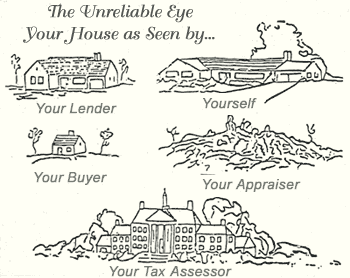
appraisal-cartoonFirst off…  If you are going to use a Real Estate Agent, make sure they are a Realtor.  That means they abide by a certain “Code of Ethics” and are held accountable.

DISCLAIMER!!!  – This blog is not a one-side… use an agent or else… kind of blog.  I will not try to convince you that you are wrong, stupid, dumb, likely-to-mess-it-up and or foolish.  As a Realtor, I find those blogs insulting as it ignores the fact that, in some specific cases, a For Sale By Owner could be the right way to go.

Now, if you are a seller and you are convinced that by not using a Realtor you are going to save 6% on your house and pocket that money, you can stop reading now.  The idea that you actually save the entire commission is not accurate.  Statistics show it is 1 to 1.5% that you might save but we will talk about that later.

The goal of this blog is to identify the real cost of using a Realtor and how to decide if an agent is right for you.

FSBO, What is it?

The FSBO (aka, For Sale By Owner), is a home that is For Sale directly from the owner without the use of a listing agent.  Some FSBO’s will offer a 3% commission to any agent who brings a buyer while others demand that the buyer pays the commission to their agent (this is a far more common practice in the commercial realm and drives the residential agents nuts every time it happens.)

In 99.99999% of the cases, the argument to use or not to use an agent hinges on commission.  If a By Owner can find the buyer, they can save roughly 6% of the gross sales price.  On a $300,000 home, quick math tells us this is $18,000.  If the By Owner pays a cooperating Buyer’s Agent a 3% commission, then they save $9,000.  Neither of these figures are small numbers and when equity in homes has been reduced as much as it has from the heights of 2007/8, it becomes a significant part of the cash generated by the sale (if not all, in many cases.)  The want (or need) to save is powerful and therefore the decision to employ an agent is not to be taken lightly.

A Nod to Historical Trends

First, an important statistic…

Did you know that traditionally, somewhere between 90 and 95% of the homes that are sold involve at least one Realtor?  This percentage may fluctuate somewhat (depending on the market) but has more or less remained within a few percentage points of 90% for a considerable amount of time.  After you remove family sales, inside sales and other non-arms length transactions, that number actually increases.  In 2014, only 4% homes sold in the US were sold directly from seller to buyer without the use of an agent.  That figure is one of the most important facts for the selling public to understand.  Statistically speaking, there is 90% or greater chance that the home you sell will involve the payment of at least 3% of the gross sales price to an agent as compensation.

If there is a 90% (or greater) chance that an owner will be paying at least 3% to a buyer’s agent to sell their home, what about the remaining 3% that would normally be paid to the listing agent?

Agents Inflate Expenses to Justify Commissions

Most times, the articles written by the agent community try to justify their existence to FSBO’s by over-inflating the costs to promote a home…which is not fair.  The web has created a far different landscape for the promotion of anything for sale (homes, cars, boats, furniture, clothes, food, used pinball machine parts, etc…) and Realtors have figure out how to find the places where property can be promoted free (or very inexpensively).  While there are fees in brochure creation, photography, MLS, web portals and other promotional sources, in total, they are relatively cheap and should not be used by the agent community as the reason to list.  Any agent who brags about spending money on their listings is one who won’t be in business very long.

To adequately promote a listing for sale and to reach the necessary people who would likely be interested in purchasing your property, you will need to spend (at least in Sarasota Fl. dollars) anywhere from $300 to maybe $3,000.

  • $300 buys you the cheapest of everything and no real promotion
  • $1,000 buys you decent signage, decent photos, professional brochures, an ad in the paper or two and maybe a little ‘Featured Listing’ status on one of the portals.
  • $3,000 buys you all of the above and a broker open house with food, drone flyover, virtual tour, direct mail and about everything else you can do to promote a home.

In reality, the majority of the expense for any agents is the fixed costs of being in business and the time it takes to do things well…not so much in the expense of carrying listings.

As agents, we have amazing tools (and even more on the way) which will allow us to promote your listing more broadly, more quickly and far less expensively than ever before.  If an agent has spent more than $3000 on  promotional materials and advertising, they have spent too much.  Likewise, if an agent justifies their existence based on spending, call someone else.

The Advice is the Key to Value

Instead of looking at expenses, look at knowledge and the issues at the forefront of our industry.

If you are an owner who is considering ‘FSBO’ as the method of sale, you should be able to answer the following questions:

  • Do you understand how to combat the effects of Zillow and Trulia on buyer behavior?
  • Do you understand how listings are pushed and syndicated?
  • Do you understand how to interpret feedback?
  • Do you understand the effect of Dodd-Frank, the new disclosure laws as well as RESPA?
  • Can you combat a flawed appraisal?
  • Do you understand the numerous laws which preclude the many actions considered to be discriminatory?

An perhaps most importantly, do you REALLY and TRULY understand what your home is worth?  The irony is, many agents can’t/don’t either…but that is a different article on another day.

The real cost of a Realtor is closer to 1.5-2.5% of the gross sales price.   Knowing this, the accurate question to whether or not to use a Realtor is:  Do you feel that guidance required to navigate the questions listed above, related to both process and market values, should be considered an expense off your bottom line or an investment in both your top and bottom lines?

To me, it is a no-brainer…provided the correct agent is employed to do the job…and that is the key point.  Identifying the population of agents and brokers in your marketplace that impact the net proceeds positively should be your goal (and there are more than 1 in almost every market, so interview several.)

If you do your homework and hire the right agent for the job, the effect on your bottom line will be far positive than if you tried to do it yourself.

* The 6% commission rate is an estimate of commission expenses and is in no way meant to imply that 6% is a mandated policy.

 A special nod to One South Realty Group of Richmond VA for info in this blog.

Buying a home in Florida and FLOOD insurance…

067129214_fema_logo

If you are looking to buy a home in Florida, this is now playing a larger roll in your home buying experience than ever before.

I am currently working with a FHA first time home buyer.  They are qualified to purchase a home for $100,000.  We are looking for a minimum of 2bed/1bth and a decent size yard.  Believe it or not, there are about 150 possibilities with that criteria between Bradenton and Venice.  They both work in Sarasota and don’t mind a small commute.  North Port and Parrish/Palmetto areas have many homes with this criteria, however, they feel the commute with the gas prices would be more than they can afford.

Here are your flood zone codes:  AE is very high risk.  A and V are high risk.  B, C and X are good.  However, you can be in a high risk area as long as your BFE (Base Flood Elevation) is above 12 feet.   You can find your BFE on your survey, if you have one.

You need to know what amount your lender is planning on for home insurance.  If it is low, have them rework the numbers to make sure you still qualify for the $100,000.00 or whatever your number is.

Now that we know what codes to look for, our available homes have dropped substantially.   We were left with about 15 financeable options.  Remember, we are financing and a bank WILL NOT finance a dilapidated home.  If there is a tarp on the roof… move on!  If you are paying cash… great!  you can get a great deal.

Back to my First Time Home Buyers…  We have placed a bid on two homes now.  First home wanted more and my buyers did not want to go higher due to location.  Now we are into the second bid on a Homepath home.  The first home has called back three times and his higher offer did not pan out apparently.  So we wait for an answer from the seller which could take a week or more.  (I will do my next blog on the difference between short sales, foreclosures, homepath, homesteps, hubzu and so on)

We are well prepared and these buyer understand the process.  I always spend the first hour with the buyers explaining to them what to expect.   After we talk about the process and they have a clear understanding, then we talk about their needs.

Here is my home buying tip for today;

Always put your I before your E when purchasing a home…  Intelligence before Emotions…  That will keep you from making poor decisions.

Happy Home Buying!!!

What 9 things Successful People never say!

I love this! The following article is from Forbes. Which of these things do you need to change in your Business Life? and Personal Life?

The answer is – your vocabulary. Though, granted, your vocabulary is heavily dependent on your mentality and the way you see your life, both personal and professional.

Here are the things you will probably never hear successful people say and the reasons why that’s the case:

1. It’s impossible!
“This can’t be done” is just not in their DNA. Successful people know that there is always a solution to any problem. Sometimes you’ll have to get creative, but there is no such thing as impossible. And when the goal seems too huge to accomplish, they tackle it in little pieces – they know that a lot of small steps eventually lead you to the top of the highest mountain.

2. I don’t care!
Passion, on the other hand, is in their DNA. You will never hear innovators say “I hate my job!” or “I don’t care!” If you don’t have this key ingredient – passion coupled with vision – you will never be able to overcome challenges and take risks to push the envelope, innovate, and grow your business.

3. Stop asking questions!
Smart people know that there is no such thing as a “silly question.” They know that as soon as curiosity halts and we stop asking questions, the radical innovation ends. Some of the most distinguished leaders, such as Steve Jobs and James Dyson, encouraged their teams to consistently question the way they should do things and challenge conventional wisdom. Their favorite questions are” “Why?” “Why not?” “What if?”

4. Why should I be the one doing this?
In any business, especially in a growing business, multiple people have to wear multiple hats. What’s more, those people to voluntarily identify gaps and take on filling them are usually the ones that get the most visibility internally, get to grow their responsibilities and teams the most, and ultimately get to build something truly amazing. “But it’s not my job to do this” is just not in their vocabulary.

5. I don’t think we should change the way we do things.
Visionary people always challenge the way things are done. They find better, quicker, more effective ways to accomplish tasks and execute on the right strategies. They push themselves into the areas they may not be comfortable with just so that they could continue to evolve and help their teams stay on the cutting edge. They understand that change is necessary and that comfortably resting on their laurels is not the path that’ll lead to continuous success.

6. Thank you, but I am not looking for any feedback.
To truly succeed one has to be open to new experiences, new ideas, and new perspectives. One has to always be open to feedback: on how you are executing, how you are shaping your vision, how you are leading. Those who are constantly open to feedback not only get the respect of their teams and colleagues, but also get an invaluable chance to look at themselves through the eyes of others. None of us are perfect, we all can use feedback to help us grow. At the end of the day you have to be yourself, there are some things you might not want to change. But sometimes feedback and diverse perspective can help shape the way you communicate with others or approach projects in a positive way.

7. But what if we fail?
Failure is just a part of business as usual. James Dyson failed 5,126 times before he created his famous bagless vacuum cleaner. Thomas Edison failed 10,000 times before he invented the light bulb. For them, failure was just another solid stepping stone to an amazing discovery, another necessary checkmark of what not to do. Successful people are not afraid to fail. They know it’s only the matter of time they do fail (everybody does), but that doesn’t stop them from innovating and trying out new things.

8. I know better!
There is no such thing as a self-made man. Behind every successful person is a smart team. Success is a team sport. Building a great team around your vision means admitting that you don’t know everything and hiring people that fill in the gaps in your knowledge, experience, and perspective, and trusting them to help you build something extraordinary.

9. But that’s just too hard.
People who achieve the most in their lives never take an easy way out at the times when it truly counts. They have the passion, the perseverance, and the grit to shape the new path. Being the first and conquering new roads is never easy. And sometimes you do have to learn from other people’s mistakes and successes to help shape your path. But at the end of the day, when the critical time comes to shape their own destiny, successful people never chose the path of less resistance.

Last year was a banner year in the fight against foreclosures, with filings hitting their lowest level since 2007.

Total foreclosure filings for 2013, including notices of default, scheduled auctions and bank repossessions, were reported on 1.36 million properties, down 26% from 2012, according to RealtyTrac.


With one in every 96 homes reporting at least one foreclosure filing in 2013, the national foreclosure rate has dropped to 1.04% — close to the historic norm of just below 1%. During the 2010 peak of the housing crisis, the national foreclosure rate was 2.23%.

Despite the improving market, the foreclosure threat continues to hang over the heads of many homeowners. In December, 9.3 million properties, or 19% of all homes, were reported to be “deeply underwater,” meaning borrowers owed at least 25% more on their mortgage than the homes was worth.

“Millions of homeowners are still living in the shadow of the massive foreclosure crisis” said Daren Blomquist, vice president at RealtyTrac. “But the shadow cast by the foreclosure crisis is shrinking as fewer distressed properties enter foreclosure and properties already in foreclosure are poised to exit in greater numbers in 2014.”

About 463,000 people lost their homes to bank repossessions in 2013, down 31% from 2012. In 2010, there were more than a million repossessions and 2.9 million foreclosure filings.

While most of the distressed properties from the bleak years have already been taken back by lenders and resold, the banks are pushing to get the remaining backlog of foreclosures through the system.

And it’s coming at a good time as home prices rebound. “There is unprecedented demand from institutional investors willing to pay with cash to buy at the foreclosure auction, helping to raise the value of properties with a foreclosure filing in 2013 by an average of 10% nationwide,” said Blomquist.

In so-called judicial foreclosure states, where foreclosures must get approved through the courts, hefty backlogs of foreclosures are just now getting worked through. Maryland, for example, saw a 107% increase in scheduled judicial foreclosure auctions in 2013. Meanwhile, New Jersey and Connecticut saw increases of 64% and 55%, respectively.

7 Random Facts About me… Facebook Requested

I received 3 different numbers so I am going with the middle number of 7.  I really hate these things because we are trying to think of the “cool” random facts to tell each other… not the boring ones.  So let me try to think of some not boring random facts…

1. When I was just 8 months old my mom took my brother to the Dr, Jelks because he was sick and Dr. Jelks sent him home with antibiotics but he took one look at me and told my mom to take me straight to the hospital…  I had Double Pneumonia.  My mom didn’t even realize I was sick.  One lung was collapsed and one was barely working.  After a few days the doctors warned my parents that I probably would not make it through the night.  But I fought back and got better.  My parents have always told me I was a survivor and could do things on my own.

2.  I was a cheerleader from the time I was 2 until I was 24.  When I was 4 years old I was cheering on the sidelines and got run over by the football players.  I had a broken collar bone.  But I went right back out the next week with my arm in a sling.

3.  One of my biggest regrets…  Just out of high school, I did some work in Tampa which lead to becoming a Tampa Bay Cheerleader.  I spent 2 months practicing and just before season I quit because of a boy.  He didn’t want me to do it and travel.  Did you hear that girls?  Guess what.. that boy is not in my life anymore and I missed out on the opportunity of a lifetime!  #Lifelesson

4.  I love to read!  Mostly mystery and suspense novels but any good book will do.  I did not learn to love books until I was in my late 30’s.  Probably because I was on the road traveling so much with lots of lonely nights in hotels.  I still love to read and make time for it.

WATERSKIING25.  I was on ESPN 3 times as a competitive water-skier with the Sarasota Ski-A-Rees.  I was the beckyskiingpyramiddonerightfirst female show director to win a tournament.

6.  I love to try new things.  I like facing my fears.  I have no want to jump out of a plane but I do like doing things that make most people uncomfortable.

7.  Ghee whiz…  I cant think of a 7.  Lets see…  I have 2 grandsons.  They make my world go round.  : )3

A Paperless Office

Can you imagine your office without file cabinets?  Without a big box full of realms of paper and a printer with expensive ink that always runs out… I can’t.  But it may be possible…  WOW!

I went to a class today and they explained a paperless world for Realtors!  You don’t understand… all of my files are at least an inch thick and that is for every customer.  I have 4 large file cabinets in my office and I am a small brokerage.  I remember when I worked at the big box real estate office, we had a huge room full of files.

I am very excited about a world without paper but how will my customers feel about it?  I put it to the test today and both customers, very different ages, breezed right through it.  I don’t understand why more Realtors are not using it.  Well, I am glad I am…  keeping up with the times…  Paperless!